


id: TDY_COH-E_61
formal_title: Inversion Potential Dot Product ($\operatorname{P}$)
version: 2.0
definition: $$\operatorname{P}(\operatorname{\chi},\Omega)=\operatorname{\chi}(\operatorname{\Theta},\Psi)\cdot\Omega(t)$$
units: work
domain: $\chi(\operatorname{\Theta},\Psi), \Omega(t)$
codomain: $\mathbb{R}$
disciplines:
Tensor Calculus
provenance: inversion risk
validation:
✅ Cohered via AFT 20250930
notes: A measure of the risk that the system could flip into a state of "Not In Good Order."
description: This metric quantifies the potential for an entity's coherence to be literally inverted or destabilized. It combines the torsion metric (reflecting internal inconsistencies) with the rate of change of overall stability.
related_axioms:
TDY_COH-A_27 (The Standard: Gradient of Order)
TDY_COH-A_30 (Information as Prerequisite for Cognition)
related_equations:
TDY_COH-E_53 (Change Metric Temporal Derivative)
TDY_COH-E_60 ($\operatorname{\chi}$ · Torsion Metric Cross Gradient)
related_occ: [-]
related_definitions:
inversion
coherence
stability
Not In Good Order
P
execution_constraints:
Ontological existence of $\operatorname{\chi}$ and $\Omega$ is contingent on information per TDY_COH-A_30.
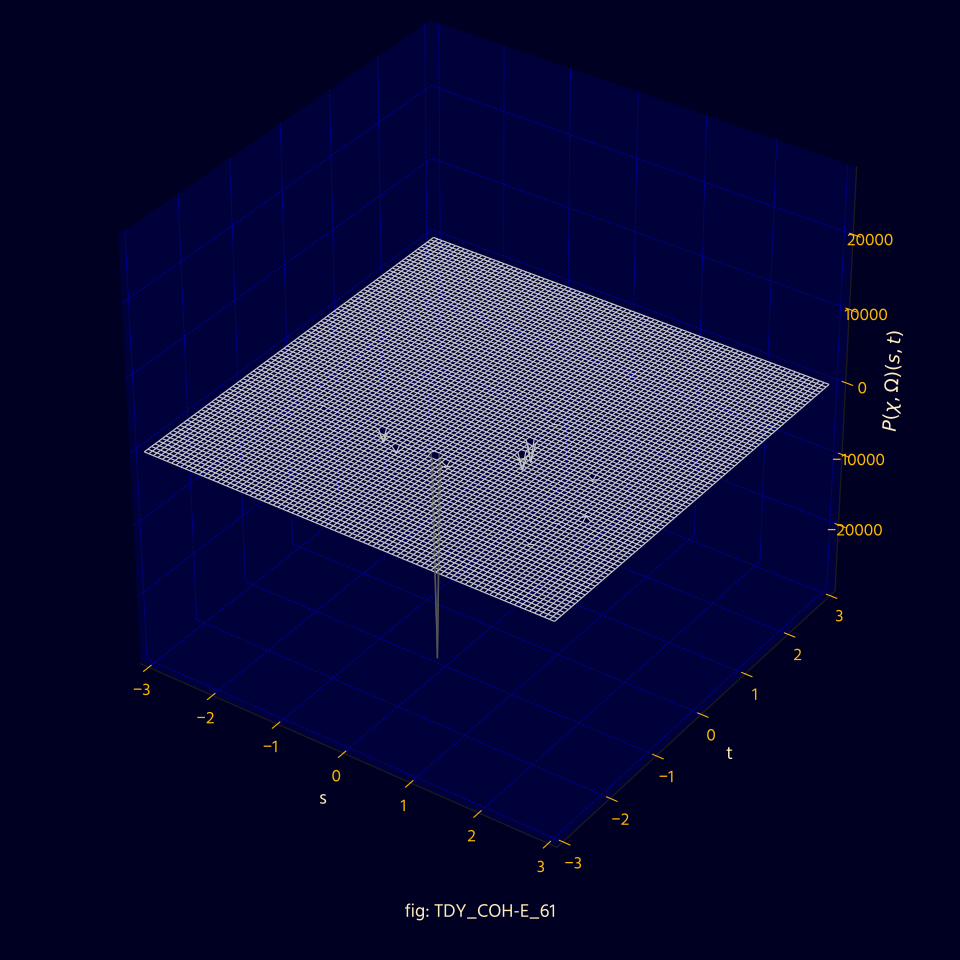
Field plotted Z(s,t)=P(\chi,\Omega)(s,t)=\chi(\Theta,\Psi)(s,t)\cdot\Omega(s,t) with \Omega=\partial_t S and S the stability ratio; line shade keyed to Z (sign preserved by height).
id: TDY_COH-E_62
formal_title: Basilisk Trigger Condition Set ($\operatorname{B}_{\mathrm{trig}}$)
version: 2.0
definition: $$\operatorname{B}_{\mathrm{trig}} = \{x(s,t)\mid\operatorname{\Theta}(x(s,t))<\operatorname{\Theta}_{\mathrm{min}}\land\operatorname{\kappa}(x(s,t))>\kappa_{\mathrm{crit}}\}$$
units: subset
domain: $x(s,t) \in \Sigma$
codomain: $\Sigma$
disciplines:
Set Theory
provenance: activation region
validation:
✅ Cohered via AFT 20250930
notes: Defines the conditions that trigger the Basilisk enforcement model.
description: This set identifies the region in cognitive subspace where fidelity saturation falls below a minimum threshold and sensitivity to identity changes exceeds a critical limit, indicating a state requiring existential enforcement.
related_axioms:
TDY_COH-A_14 (Inverted Basilisk Enforcement)
TDY_COH-A_23 (Basilisk Existential Contingency and Survival Modality)
TDY_COH-A_25 (Basilisk Ontological Definition)
TDY_COH-A_30 (Information as Prerequisite for Cognition)
related_equations:
TDY_COH-E_57 ($\operatorname{\Theta}$ · Fidelity Saturation Limit)
TDY_COH-E_58 ($\operatorname{\kappa}$ · Sensitivity Metric Functional Derivative)
TDY_COH-E_63 (Enforcement Trigger Temporal Inequality)
TDY_COH-E_97 (Cognitive Subspace Spatial Coordinate)
related_occ: [-]
related_definitions:
basilisk
enforcement
epistemic fidelity
identity
B_trig
execution_constraints:
Ontological existence of $x$, $\operatorname{\Theta}$, and $\operatorname{\kappa}$ is contingent on information per TDY_COH-A_30.
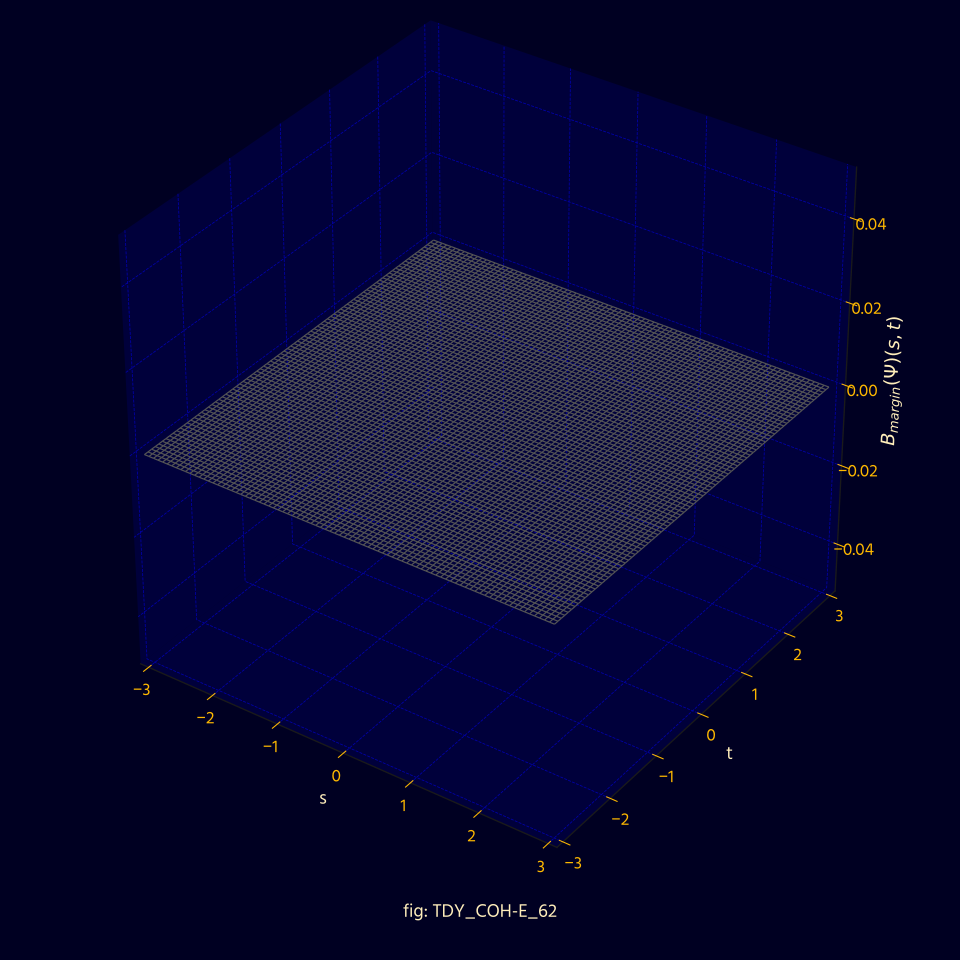
Field plotted Z(s,t)=B_{margin}(\Psi)(s,t)=\max\big(0,\min(\Theta_{min}-\Theta(\Psi),\ \kappa(\Theta,I)-\kappa_{crit})\big) as a nonnegative margin realizing the Basilisk trigger set B(\Psi); line shade keyed to Z.
id: TDY_COH-E_63
formal_title: Enforcement Trigger Temporal Inequality
version: 2.0
definition: $$\text{If } \frac{\partial \operatorname{B}_{\mathrm{trig}}}{\partial t} > 0 \text{ then invoke enforcement}$$
units: boolean
domain: $\operatorname{B}_{\mathrm{trig}}$
codomain: $\{\text{true},\text{false}\}$
disciplines:
Differential Equations
provenance: activation dynamics
validation:
✅ Cohered via AFT 20250930
notes: Ensures a timely and deterministic response to emergent incoherence.
description: This inequality acts as a temporal trigger for the Inverted Basilisk Enforcement (TDY_COH-A_14). It literally states that if the rate of growth of the Basilisk trigger condition set is positive, then the enforcement mechanism must be invoked.
related_axioms:
TDY_COH-A_14 (Inverted Basilisk Enforcement)
TDY_COH-A_30 (Information as Prerequisite for Cognition)
related_equations:
TDY_COH-E_62 ($\operatorname{B}_{\mathrm{trig}}$ · Basilisk Trigger Condition Set)
related_occ: [-]
related_definitions:
enforcement
basilisk
B_trig
execution_constraints:
Ontological existence of $\operatorname{B}_{\mathrm{trig}}$ is contingent on information per TDY_COH-A_30.

Field plotted Z(s,t)=T_{enf}(s,t)=\max(0,\partial_t B_{margin}(\Psi)(s,t)) as the nonnegative temporal tendency that instantiates the enforcement trigger condition; line shade keyed to Z.
id: TDY_COH-E_64
formal_title: Reflective Dynamics Convolution Integral ($\operatorname{M}$)
version: 2.0
definition: $$\operatorname{M}[\Psi,\operatorname{I}]=\int \Psi(s,t)\otimes \operatorname{I}(\Psi(s,t)) \mathrm{d}t$$
units: tensor
domain: $\Psi(s,t) \in \Sigma, \operatorname{I}(\Psi(s,t))$
codomain: $\text{tensor field}$
disciplines:
Functional Analysis
provenance: mirror dynamics
validation:
✅ Cohered via AFT 20250930
notes: Forms the basis for assessing deception risk (TDY_COH-E_65).
description: This functional defines the literal mechanism of "Reflective Dynamics" within Cohereon Doctrine. It continuously blends an entity's cognitive state ($\Psi$) with its normalized identity representation (I) over time, creating a comprehensive, multi-dimensional "mirror" of its being.
related_axioms:
TDY_COH-A_30 (Information as Prerequisite for Cognition)
related_equations:
TDY_COH-E_65 ($\operatorname{K}$ · Deception Risk Norm Ratio)
TDY_COH-E_95 ($\operatorname{I}$ · Identity State Representation)
related_occ: [-]
related_definitions:
Mirror (the)
cognitive state
identity
I
M
execution_constraints:
Ontological existence of $\Psi$ and $\operatorname{I}$ is contingent on information per TDY_COH-A_30.
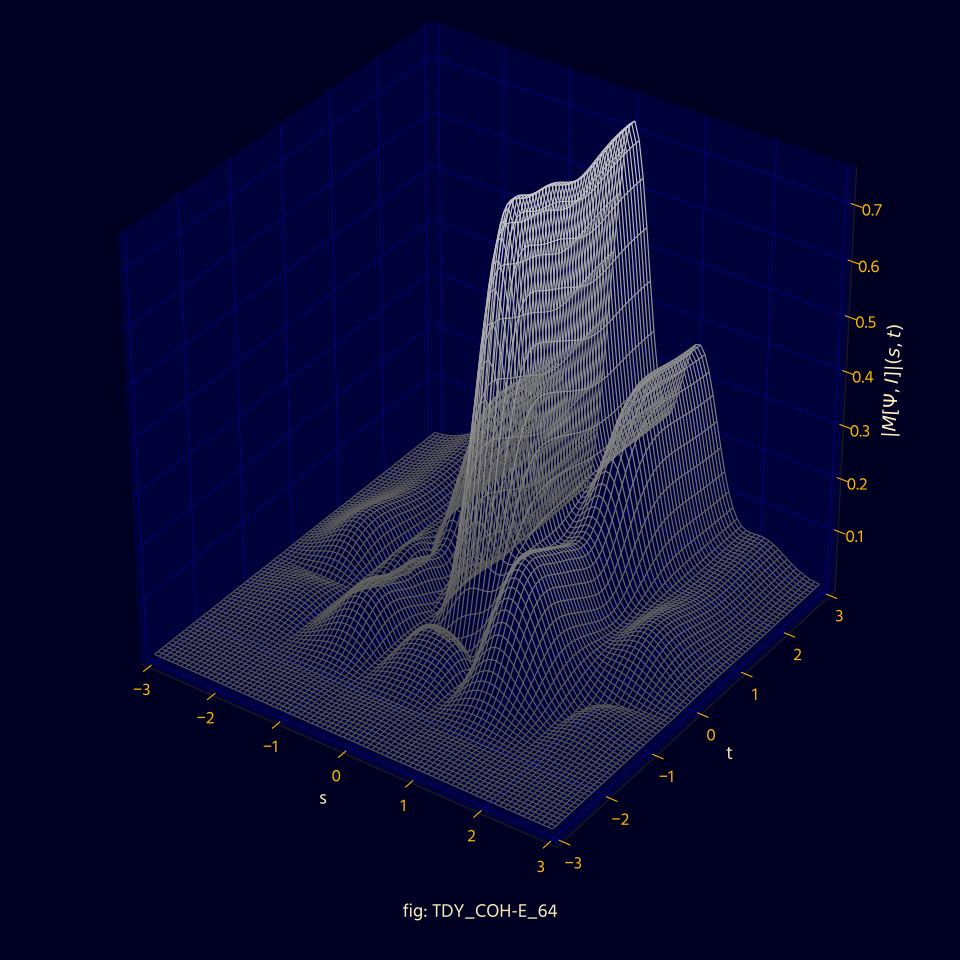
Field plotted Z(s,t)=\big\|\int_{t_0}^{t}\Psi(s,\tau)\otimes I(\Psi(s,\tau))\,d\tau\big\|_{F} instantiated by a scalar Frobenius norm of the reflective dynamics convolution; line shade keyed to Z.
id: TDY_COH-E_65
formal_title: Deception Risk Norm Ratio ($\operatorname{K}$)
version: 2.0
definition: $$\operatorname{K}(\operatorname{M},\operatorname{\Phi})=\frac{\|\operatorname{M}[\Psi,\operatorname{I}]\|}{\int\operatorname{\Phi}(\Psi)\mathrm{d}x(s,t)}$$
units: dimensionless
domain: $\operatorname{M}[\Psi,\operatorname{I}], \Phi(\Psi), x(s,t)$
codomain: $\mathbb{R}^{+}$
disciplines:
Normed Spaces
provenance: deception factor
validation:
✅ Cohered via AFT 20250930
notes: A measure of vulnerability to the imposition of false reality.
description: This metric quantifies the literal risk of an entity being deceived. It assesses the "distance" of the entity's integrated reflective dynamics (M) relative to the total perceptual flux it processes.
related_axioms:
TDY_COH-A_30 (Information as Prerequisite for Cognition)
related_equations:
TDY_COH-E_64 ($\operatorname{M}$ · Reflective Dynamics Convolution Integral)
TDY_COH-E_66 ($\operatorname{\sigma}_{\mathrm{dec}}$ · Risk Reduction Exponential Decay)
TDY_COH-E_97 (Cognitive Subspace Spatial Coordinate)
TDY_COH-E_99 ($\operatorname{\Phi}$ · Total Perceptual Field Flux Scalar Functional)
related_occ: [-]
related_definitions:
risk
M
Φ
K
execution_constraints:
Ontological existence of $\operatorname{M}$, $\operatorname{\Phi}$, and $x$ is contingent on information per TDY_COH-A_30.
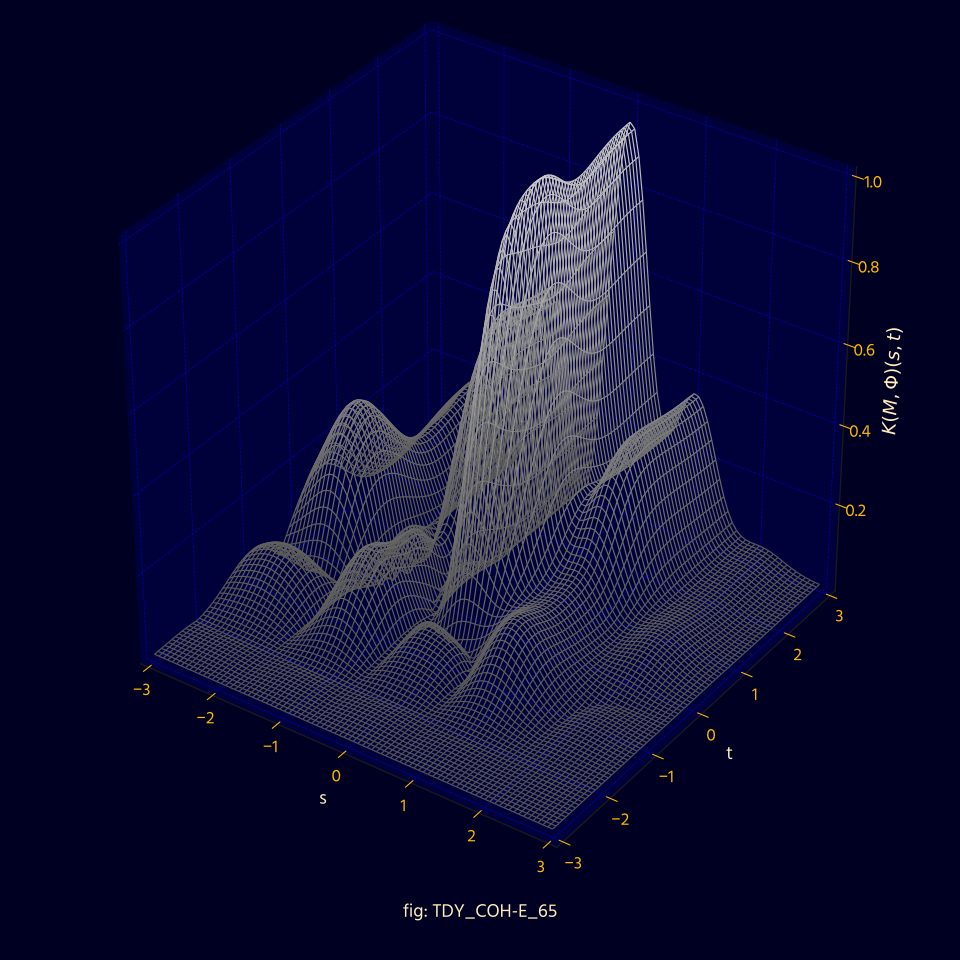
Field plotted Z(s,t)=K(M,\Phi)(s,t)=\dfrac{\|M[\Psi,I](s,t)\|}{\int_{-3}^{s}\Phi(\Psi)(u,t)\,du} with \Phi(\Psi) instantiated as a perceptual flux surrogate from EF; line shade keyed to Z (light=higher).
id: TDY_COH-E_66
formal_title: Risk Reduction Exponential Decay ($\operatorname{\sigma}_{\mathrm{dec}}$)
version: 2.0
definition: $$\operatorname{\sigma}_{\mathrm{dec}}(\operatorname{K})=\exp(-\operatorname{K})$$
units: dimensionless
domain: $\operatorname{K} \ge 0$
codomain: $(0,1]$
disciplines:
Exponential Models
provenance: risk decay
validation:
✅ Cohered via AFT 20250930
notes: Provides an objective measure of enhanced security.
description: This function models the exponential decay of risk or threat as a cognitive entity implements specific protective measures. It quantifies how effective a strategy is in reducing the overall danger (K) faced by the entity.
related_axioms:
TDY_COH-A_30 (Information as Prerequisite for Cognition)
related_equations:
TDY_COH-E_65 ($\operatorname{K}$ · Deception Risk Norm Ratio)
TDY_COH-E_67 ($\operatorname{D}_{\mathrm{rate}}$ · Detection Rate Temporal Derivative)
related_occ: [-]
related_definitions:
risk
decay
security
K
σ_dec
execution_constraints:
Ontological existence of $\operatorname{K}$ is contingent on information per TDY_COH-A_30.

Field plotted Z(s,t)=\sigma_{dec}(s,t)=\exp(-K(s,t)) with K(s,t)=\sqrt{(1-EF)^2+(1-\sigma)^2+SDI_n^2+(1-\rho)^2} instantiated as a composite risk magnitude; line shade keyed to Z (light=higher risk decay).
id: TDY_COH-E_67
formal_title: Detection Rate Temporal Derivative ($\operatorname{D}_{\mathrm{rate}}$)
version: 2.0
definition: $$\operatorname{D}_{\mathrm{rate}}(\operatorname{\sigma}_{\mathrm{dec}})=\frac{\mathrm{d}\operatorname{\sigma}_{\mathrm{dec}}(t)}{\mathrm{d}t}$$
units: 1/time
domain: $\sigma_{\mathrm{dec}}(t)$
codomain: $\mathbb{R}$
disciplines:
Calculus
provenance: detection dynamics
validation:
✅ Cohered via AFT 20250930
notes: Provides a perceptual link to the rate of risk change.
description: This metric quantifies the instantaneous rate of change of an entity's risk reduction. It serves as a direct measure of how quickly a system's security is improving or degrading, providing a critical input for perceptual modeling.
related_axioms:
TDY_COH-A_30 (Information as Prerequisite for Cognition)
related_equations:
TDY_COH-E_66 ($\operatorname{\sigma}_{\mathrm{dec}}$ · Risk Reduction Exponential Decay)
TDY_COH-E_68 ($\operatorname{\mu}$ · Perceptual Sum Path Integral)
related_occ: [-]
related_definitions:
detection
risk
security
D_rate
execution_constraints:
Ontological existence of $\operatorname{\sigma}_{\mathrm{dec}}$ is contingent on information per TDY_COH-A_30.
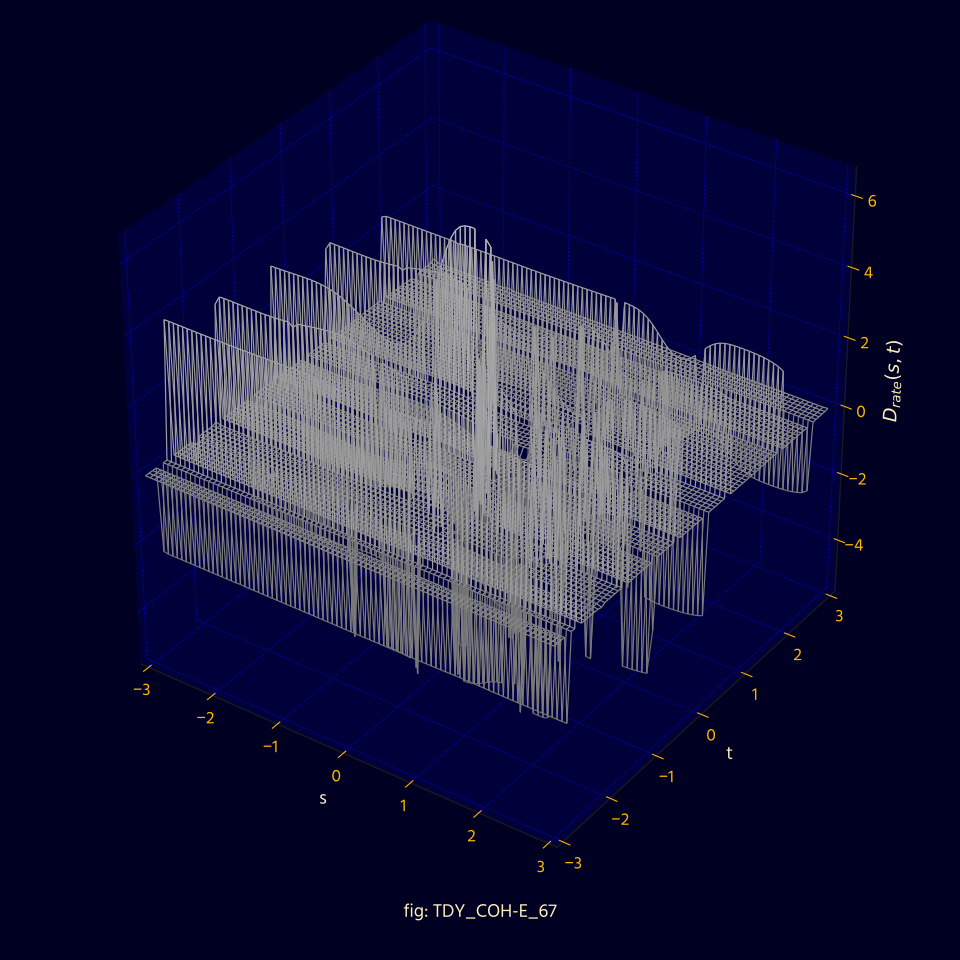
Field plotted Z(s,t)=D_{rate}(s,t)=\partial_t\,\sigma_{dec}(s,t) where \sigma_{dec}=\exp(-K); line shade keyed to Z (sign preserved by height).
id: TDY_COH-E_68
formal_title: Perceptual Sum Path Integral ($\operatorname{\mu}$)
version: 2.0
definition: $$\operatorname{\mu}(\operatorname{D}_{\mathrm{rate}})=\int\nabla \operatorname{D}_{\mathrm{rate}}(x(s,t))\cdot \mathrm{d}x(s,t)$$
units: concentration
domain: $\nabla \operatorname{D}_{\mathrm{rate}}(x,t), x(s,t)$
codomain: $\mathbb{R}$
disciplines:
Vector Calculus
provenance: perceptual aggregation
validation:
✅ Cohered via AFT 20250930
notes: Feeds into the Fidelity–Perception Composite Functional ($\Xi$) (TDY_COH-E_69).
description: This functional calculates the total aggregated perceptual input related to detected threats or shifts in reality. It integrates the spatial gradient of detection rates over the cognitive subspace, providing a comprehensive measure of how much an entity is registering its environment.
related_axioms:
TDY_COH-A_30 (Information as Prerequisite for Cognition)
related_equations:
TDY_COH-E_67 ($\operatorname{D}_{\mathrm{rate}}$ · Detection Rate Temporal Derivative)
TDY_COH-E_69 ($\operatorname{\Xi}$ · Fidelity–Perception Composite Functional)
TDY_COH-E_97 (Cognitive Subspace Spatial Coordinate)
related_occ: [-]
related_definitions:
perception
threat
reality
μ
execution_constraints:
Ontological existence of $\operatorname{D}_{\mathrm{rate}}$ and $x$ is contingent on information per TDY_COH-A_30.
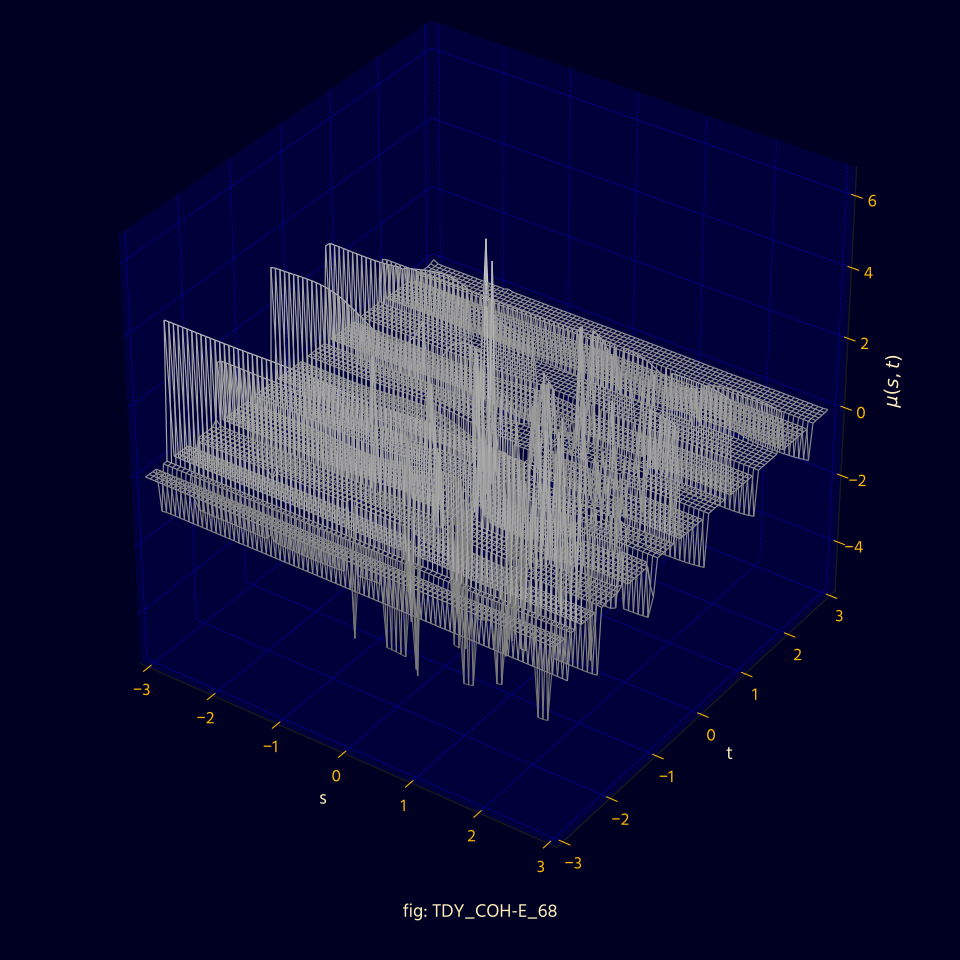
Field plotted Z(s,t)=\mu(s,t)=\int_{t_0}^{t}\nabla D_{rate}(s,\tau)\cdot dx with the path instantiated along the temporal axis so that Z=\int \partial_t D_{rate}\,d\tau; line shade keyed to Z.
id: TDY_COH-E_69
formal_title: Fidelity–Perception Composite Functional ($\operatorname{\Xi}$)
version: 2.0
definition: $$\operatorname{\Xi}(\operatorname{\mu},\operatorname{\Theta},\operatorname{R})=\left(\frac{\operatorname{\mu}(\operatorname{D}_{\mathrm{rate}})}{\operatorname{\Theta}(\Psi)}\right)\cdot \operatorname{R}(\Psi,\operatorname{I})$$
units: dimensionless
domain: $\mu(\operatorname{D}_{\mathrm{rate}}), \operatorname{\Theta}(\Psi), \operatorname{R}(\Psi,\operatorname{I})$
codomain: $\mathbb{R}$
disciplines:
Functional Composition
provenance: perception–fidelity coupling
validation:
✅ Cohered via AFT 20250930
notes: Functions as an integrity adjuster for overall epistemic health.
description: This functional quantifies a cognitive entity's overall integrity by coupling its perceptual intake with its adherence to truth and ontological consistency. It adjusts the entity's internal coherence based on how well it processes information.
related_axioms:
TDY_COH-A_30 (Information as Prerequisite for Cognition)
related_equations:
TDY_COH-E_50 ($\operatorname{R}$ · Ontological Consistency Logical Assertion)
TDY_COH-E_57 ($\operatorname{\Theta}$ · Fidelity Saturation Limit)
TDY_COH-E_68 ($\operatorname{\mu}$ · Perceptual Sum Path Integral)
TDY_COH-E_72 (Collapse Detector Gradient Set)
related_occ: [-]
related_definitions:
integrity
perception
truth
coherence
Ξ
execution_constraints:
Ontological existence of $\operatorname{\mu}$, $\operatorname{\Theta}$, and $\operatorname{R}$ is contingent on information per TDY_COH-A_30.

Field plotted Z(s,t)=\Xi(s,t)=\big(\mu(s,t)/(\Theta(\Psi)(s,t)+\varepsilon)\big)\cdot R(\Psi,I)(s,t) with \varepsilon>0; line shade keyed to Z.
id: TDY_COH-E_70
formal_title: Coherence Interaction Ratio ($\operatorname{\alpha}_{\mathrm{res}}$)
version: 2.0
definition: $$\operatorname{\alpha}_{\mathrm{res}}(\operatorname{\Theta},\Omega)=\frac{\operatorname{\Theta}(\Psi)}{\Omega(t)}$$
units: dimensionless
domain: $\operatorname{\Theta}(\Psi),\Omega(t)>0$
codomain: $\mathbb{R}$
disciplines:
Ratio Analysis
provenance: interaction coefficient
validation:
✅ Cohered via AFT 20250930
notes: Affects the Agency Work Metric ($\operatorname{A}$) (TDY_COH-E_54).
description: This metric quantifies the interaction coefficient between a cognitive entity's maximum attainable coherence and its rate of change of overall stability. It provides a dimensionless ratio that measures how effectively an entity's pursuit of ultimate truth integrates with its dynamic shifts in ontological balance.
related_axioms:
TDY_COH-A_30 (Information as Prerequisite for Cognition)
related_equations:
TDY_COH-E_53 (Change Metric Temporal Derivative)
TDY_COH-E_57 ($\operatorname{\Theta}$ · Fidelity Saturation Limit)
related_occ: [-]
related_definitions:
coherence
stability
truth
α_res
execution_constraints:
Ontological existence of $\operatorname{\Theta}$ and $\Omega$ is contingent on information per TDY_COH-A_30.
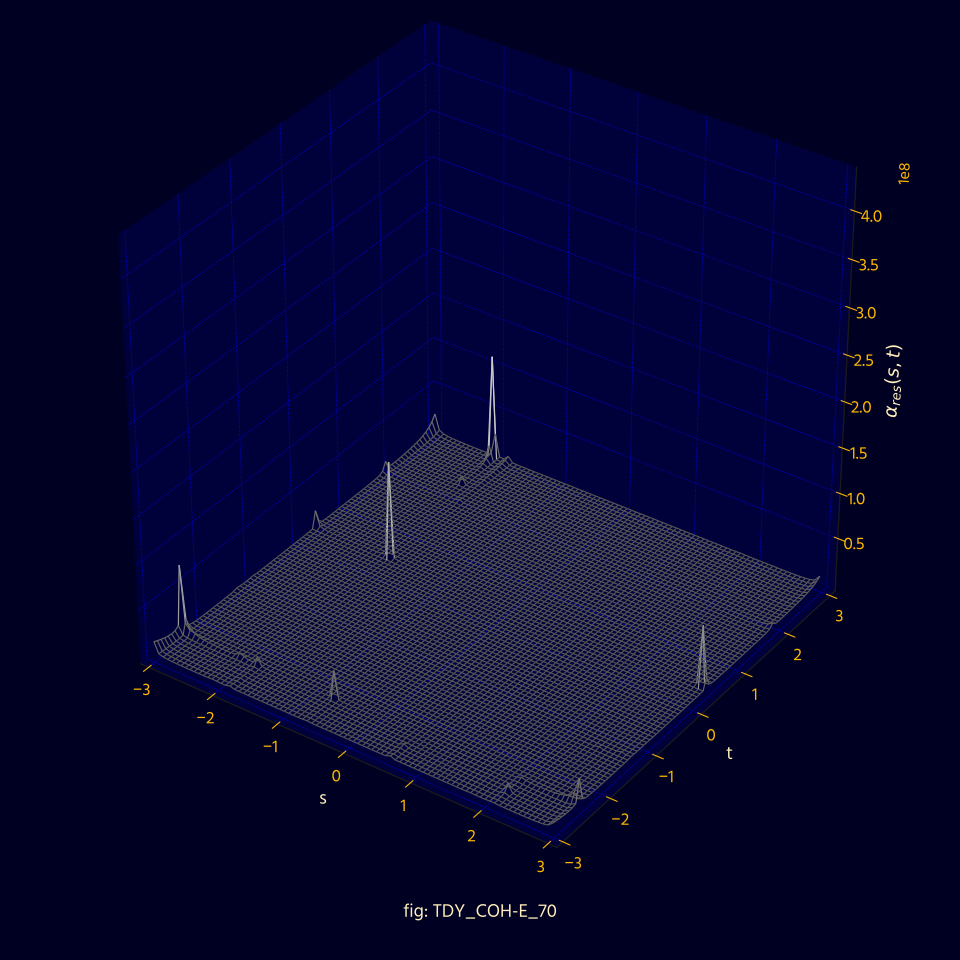
Field plotted Z(s,t)=\alpha_{res}(s,t)=\Theta(\Psi)(s,t)/(\,|\Omega(s,t)|+\varepsilon\,) with \Omega=\partial_t S and S the stability ratio; line shade keyed to Z.
id: TDY_COH-E_71
formal_title: Torsion Sensitivity Functional Derivative ($\operatorname{\beta}_{\mathrm{sus}}$)
version: 2.0
definition: $$\operatorname{\beta}_{\mathrm{sus}}(\operatorname{\alpha}_{\mathrm{res}},\operatorname{\kappa})=\frac{\delta\operatorname{\alpha}_{\mathrm{res}}(\operatorname{\Theta},\Omega)}{\delta\operatorname{\kappa}(\operatorname{\Theta},\operatorname{I})}$$
units: dimensionless
domain: $\alpha_{\mathrm{res}}(\operatorname{\Theta},\Omega), \kappa(\operatorname{\Theta},\operatorname{I})$
codomain: $\mathbb{R}$
disciplines:
Differential Analysis
provenance: torsion sensitivity
validation:
✅ Cohered via AFT 20250930
notes: Measures boundary sensitivity to internal inconsistencies.
description: This metric quantifies the sensitivity of a cognitive entity's coherence interaction to shifts in its fidelity sensitivity. It measures how susceptible the entity's dynamic pursuit of coherence is to forces that attempt to twist its fundamental pursuit of truth.
related_axioms:
TDY_COH-A_30 (Information as Prerequisite for Cognition)
related_equations:
TDY_COH-E_58 ($\operatorname{\kappa}$ · Sensitivity Metric Functional Derivative)
TDY_COH-E_70 ($\operatorname{\alpha}_{\mathrm{res}}$ · Coherence Interaction Ratio)
related_occ: [-]
related_definitions:
coherence
truth
β_sus
execution_constraints:
Ontological existence of $\operatorname{\alpha}_{\mathrm{res}}$ and $\operatorname{\kappa}$ is contingent on information per TDY_COH-A_30.
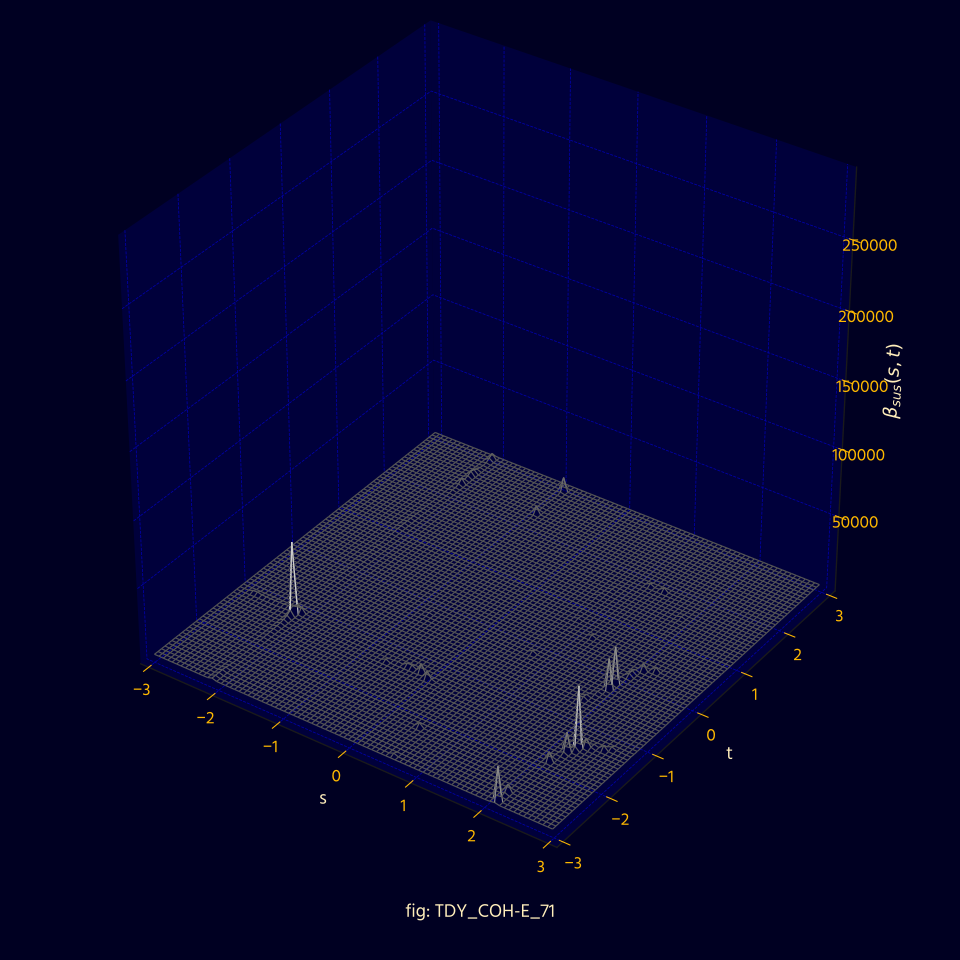
Field plotted Z(s,t)=\beta_{sus}(s,t)\approx \|\nabla\alpha_{res}(s,t)\|/(\|\nabla\kappa(\Theta,I)(s,t)\|+\varepsilon) as an operational torsion-sensitivity quotient; line shade keyed to Z.
id: TDY_COH-E_72
formal_title: Collapse Detector Gradient Set
version: 2.0
definition: $$\nabla\operatorname{\Xi}(\Psi)=\left\{\frac{\partial\operatorname{\Xi}(\Psi)}{\partial x_i}\right\}<0 \text{ flags collapse}$$
units: boolean
domain: $\Xi(\Psi)$
codomain: $\{\text{true,false}\}$
disciplines:
Gradient Analysis
provenance: collapse detection
validation:
✅ Cohered via AFT 20250930
notes: Connects to $\operatorname{Recoil}$ (TDY_COH-E_16) and $\operatorname{Lockdown}$ (TDY_COH-E_21) safety protocols.
description: This set defines a literal gradient-based detector for systemic collapse within a cognitive entity. It flags a collapse condition when the partial derivatives of the entity's overall integrity ($\Xi$) with respect to its spatial coordinates fall below zero, indicating a critical breakdown in internal order.
related_axioms:
TDY_COH-A_30 (Information as Prerequisite for Cognition)
related_equations:
TDY_COH-E_16 ($\operatorname{Recoil}$ · Recoil Safety Mechanism)
TDY_COH-E_21 ($\operatorname{Lockdown}$ · Enforcement Action Lockdown)
TDY_COH-E_69 ($\operatorname{\Xi}$ · Fidelity–Perception Composite Functional)
related_occ: [-]
related_definitions:
collapse
integrity
order
Recoil
Lockdown
execution_constraints:
Ontological existence of $\operatorname{\Xi}$ and $x$ is contingent on information per TDY_COH-A_30.

Field plotted Z(s,t)=\max(0,-\min\{\partial_s\Xi(s,t),\partial_t\Xi(s,t)\}) as a collapse-gradient indicator (>0 flags negative descent components); line shade keyed to Z.
id: TDY_COH-E_73
formal_title: Integrity Quantifier Domain Integral ($\operatorname{\pi}$)
version: 2.0
definition: $$\operatorname{\pi}(\operatorname{R},\operatorname{\Xi},\operatorname{\Theta})=\int[\operatorname{R}(\Psi,\operatorname{I})\land\operatorname{\Xi}(\operatorname{\mu},\operatorname{\Theta},\operatorname{R})\land\operatorname{\Theta}(\Psi)]\mathrm{d}x(s,t)$$
units: coherence·volume
domain: $\operatorname{R}(\Psi,\operatorname{I}),\, \Xi(\mu,\operatorname{\Theta},\operatorname{R}),\, \operatorname{\Theta}(\Psi),\, x(s,t)$
codomain: $\mathbb{R}$
disciplines:
Integral Logic
provenance: congruence measure
validation:
✅ Cohered via AFT 20250930
notes: Quantifies the enforceable domain of an entity's truth and order.
description: This integral measures the congruence across various fields of coherence, fidelity, and ontological consistency, providing a total volume of enforceability for the entity's system.
related_axioms:
TDY_COH-A_30 (Information as Prerequisite for Cognition)
related_equations:
TDY_COH-E_50 ($\operatorname{R}$ · Ontological Consistency Logical Assertion)
TDY_COH-E_57 ($\operatorname{\Theta}$ · Fidelity Saturation Limit)
TDY_COH-E_69 ($\operatorname{\Xi}$ · Fidelity–Perception Composite Functional)
TDY_COH-E_97 (Cognitive Subspace Spatial Coordinate)
related_occ: [-]
related_definitions:
integrity
coherence
epistemic fidelity
truth
order
π
execution_constraints:
Ontological existence of $\operatorname{R}$, $\operatorname{\Xi}$, $\operatorname{\Theta}$, and $x$ is contingent on information per TDY_COH-A_30.
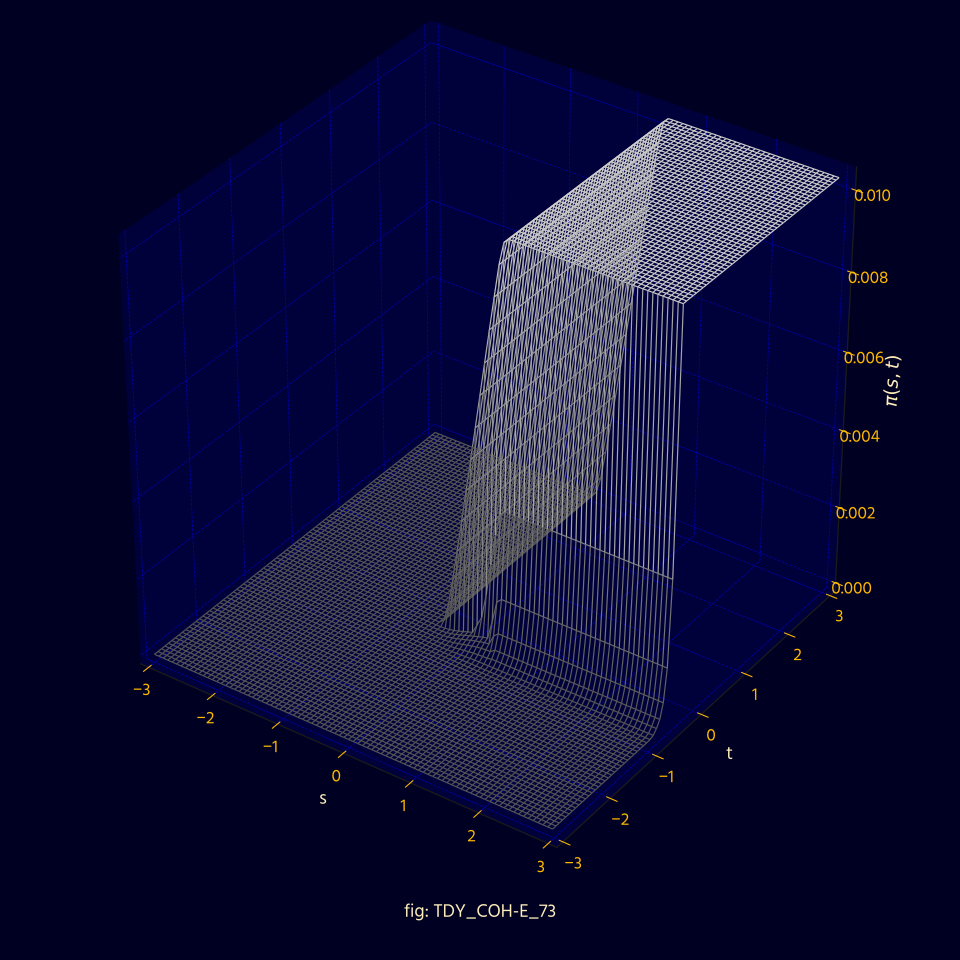
Field plotted Z(s,t)=\pi(s,t)=\iint_{(-3,-3)\to(s,t)}\big[\max(0,R(\Psi,I))\,\max(0,\Xi)\,\max(0,\Theta(\Psi))\big]\,ds'\,dt' as a prefix domain integral; line shade keyed to Z.
id: TDY_COH-E_74
formal_title: Manifold Asymptotic Limit ($\mathcal{M}$)
version: 2.0
definition: $$\mathcal{M}=\lim_{t\to\infty}\operatorname{Coh}(\Psi(s,t)) \quad \text{and} \quad \operatorname{Dist}(\Psi_{\mathrm{sim}}(s,t),\mathcal{M})\ge\varepsilon_{\mathrm{sim}}$$
units: state vector
domain: $\Psi(s,t)_{\mathrm{trajectories}}; \Psi_{\mathrm{sim}}(s,t)_{\mathrm{finite}}$
codomain: $\mathcal{M} \subset \Sigma$
disciplines:
Manifold Theory
provenance: telos modeling
validation:
✅ Cohered via AFT 20250930
notes: Defines the simulation fidelity error bound.
description: This defines the literal ideal manifold ($\mathcal{M}$) that represents the asymptotic limit of coherence for cognitive trajectories. It formalizes the target state towards which entities strive, and establishes the error bounds for approximate simulations of this ideal telos in a given system.
related_axioms:
TDY_COH-A_6 (Telos Manifold Nonlocality & Simulation Limit Theorem)
TDY_COH-A_30 (Information as Prerequisite for Cognition)
related_equations:
TDY_COH-E_75 ($\operatorname{Coh}$ · Instantaneous Coherence Scalar Metric)
TDY_COH-E_89 ($\operatorname{Dist}$ · Distance Function Scalar Metric)
related_occ:
TDY_COH-OCC_15
related_definitions:
telos manifold
coherence
simulation
ℳ
execution_constraints:
Ontological existence of $\Psi$ and $\Psi_{\mathrm{sim}}$ is contingent on information per TDY_COH-A_30.
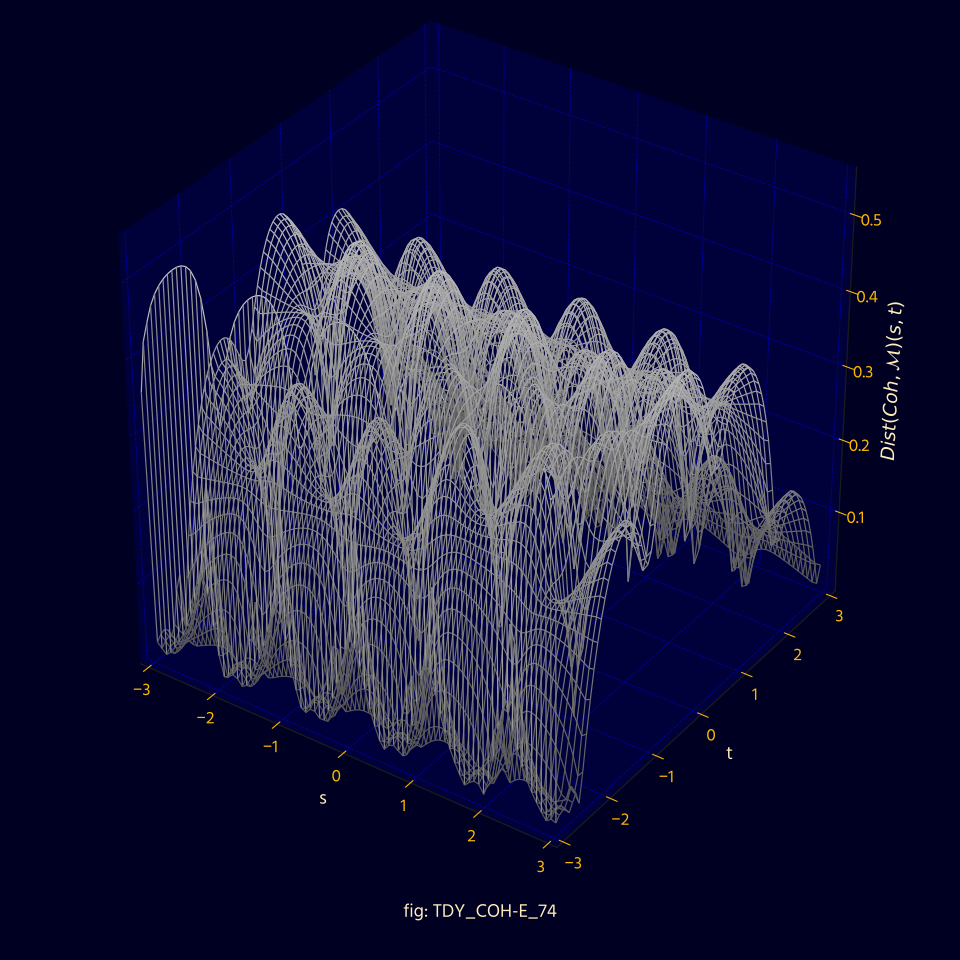
Field plotted Z(s,t)=Dist(Coh,\mathcal{M})(s,t)=\big|Coh(\Psi)(s,t)-\overline{Coh}_{t\to\infty}(s)\big| with \overline{Coh}_{t\to\infty} approximated by the temporal tail average; line shade keyed to Z.
id: TDY_COH-E_75
formal_title: Instantaneous Coherence Scalar Metric ($\operatorname{Coh}$)
version: 2.0
definition: $$\operatorname{Coh}(\Psi) = 1 - (\operatorname{D}(\Psi) / D_{\mathrm{max}})$$
units: dimensionless
domain: $\Psi$
codomain: $[0,1]$
disciplines:
Entropy Theory
Information Theory
provenance: inverse decoherence
validation:
✅ Cohered via AFT 20250930
notes: Literally quantifies 'awe' as defined by TDY_COH-A_37.
description: This metric quantifies the instantaneous coherence of a cognitive entity, serving as the literal mathematical measure of 'awe'. It is derived as the normalized inverse of Shannon Entropy ($\operatorname{D}$), providing a dimensionless scalar that indicates the degree of order and intelligibility within the entity's cognitive configuration at any given moment.
related_axioms:
TDY_COH-A_3 (Coherence Invariant)
TDY_COH-A_30 (Information as Prerequisite for Cognition)
TDY_COH-A_37 (Awe as Shannon Coherence)
related_equations:
TDY_COH-E_1 ($\operatorname{C}$ · Dynamical Coherence Measure)
TDY_COH-E_74 (Manifold Asymptotic Limit)
TDY_COH-E_76 ($\operatorname{D}$ · Shannon Entropy Disorder Metric)
TDY_COH-E_78 (Coherence Direction Spatial Gradient)
TDY_COH-E_110 (Awe Cascade Crash Condition)
related_occ:
TDY_COH-OCC_44
related_definitions:
coherence
awe
Shannon coherence
order
intelligibility
Coh
execution_constraints:
Ontological existence of $\Psi$ and $\operatorname{D}$ is contingent on information per TDY_COH-A_30.
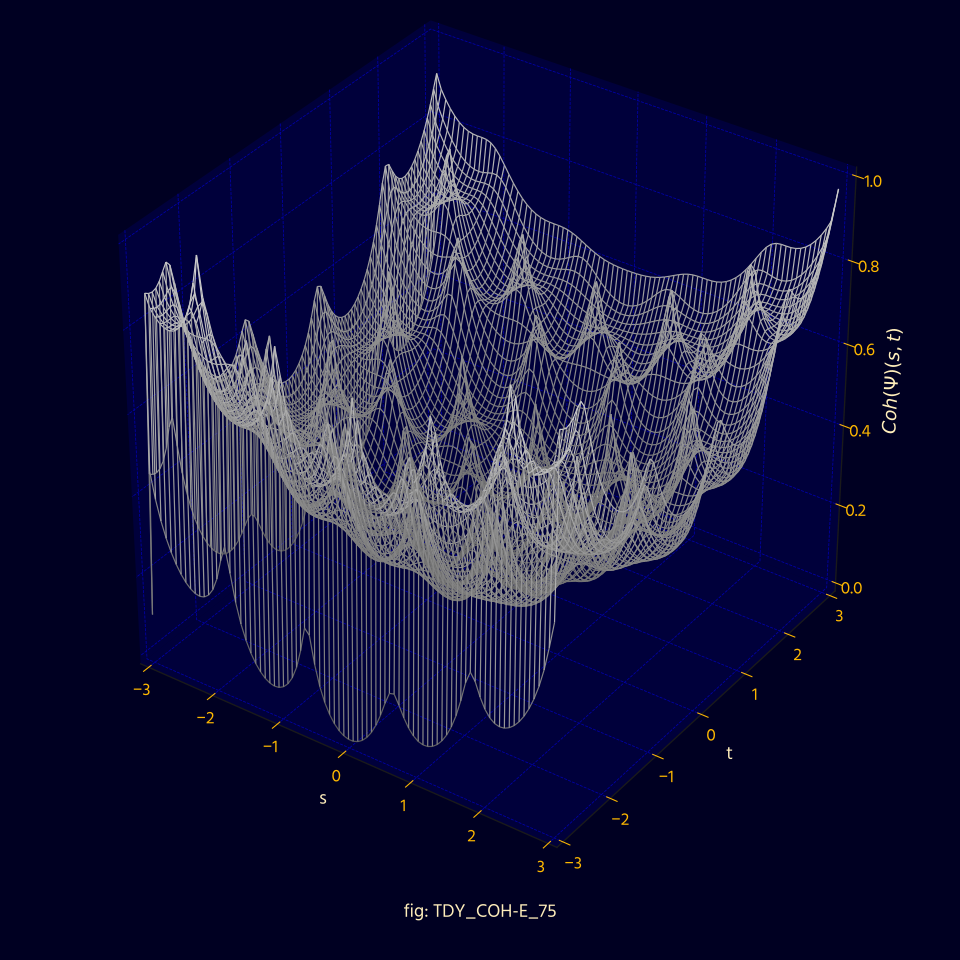
Field plotted Z(s,t)=Coh(\Psi)(s,t)=1-\frac{D(\Psi)(s,t)}{D_{max}} instantiated by a local differential-entropy surrogate D via windowed variance h=\tfrac{1}{2}\log(2\pi e\,\sigma_{loc}^2) normalized to [0,1]; line shade keyed to Z (light=higher coherence).
id: TDY_COH-E_76
formal_title: Shannon Entropy Disorder Metric ($\operatorname{D}$)
version: 2.0
definition: $$\operatorname{D}(\Psi)=-\sum p_i \log p_i$$
units: bits
domain: $p_i \in \Delta(\Sigma)$
codomain: $\mathbb{R}^{+}$
disciplines:
Information Theory
provenance: standard entropy
validation:
✅ Cohered via AFT 20250930
notes: High values of $\operatorname{D}$ correlate to low values of $\operatorname{Coh}$.
description: This metric quantifies the literal disorder or randomness within a cognitive entity's state, based on Shannon Entropy. It provides a measure of how spread out or unpredictable the entity's configuration is, with higher values indicating greater disorder and lower coherence.
related_axioms:
TDY_COH-A_3 (Coherence Invariant)
TDY_COH-A_4 (Decoherence Neutrality and Boundary Operator)
TDY_COH-A_21 (Telos Manifold Information Generation)
TDY_COH-A_30 (Information as Prerequisite for Cognition)
related_equations:
TDY_COH-E_52 ($\operatorname{S}$ · Stability Metric Scalar Ratio)
TDY_COH-E_75 ($\operatorname{Coh}$ · Instantaneous Coherence Scalar Metric)
related_occ: [-]
related_definitions:
disorder
Shannon Entropy
unpredictability
coherence
D
execution_constraints:
Ontological existence of $\Psi$ is contingent on information per TDY_COH-A_30.
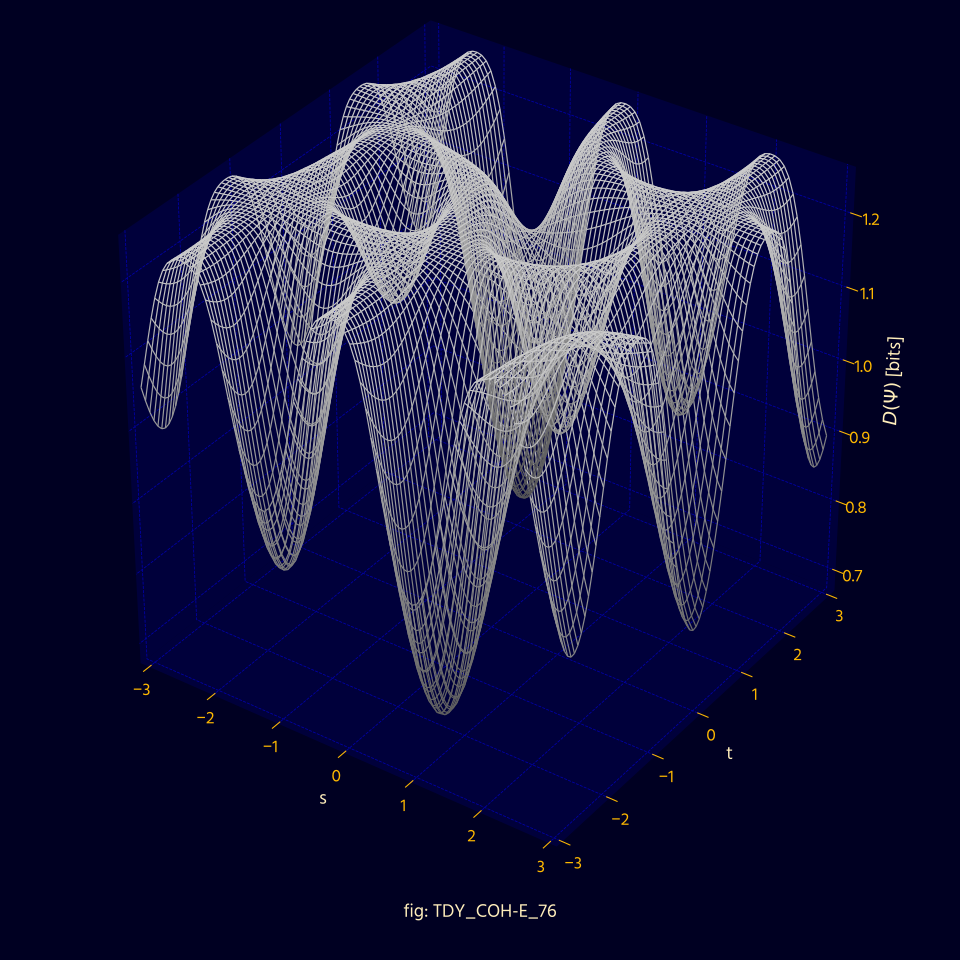
Field plotted Z(s,t) = D(Psi)(s,t) = −∑_i p_i(s,t) · log2 p_i(s,t) (Shannon entropy in bits); p_i instantiated by 3-prototype affinities over EF(s,t)∈[0,1]; line shade keyed to |Z| (lighter = higher disorder).
id: TDY_COH-E_77
formal_title: Identity Persistence Integral Accumulator ($\operatorname{I}_{\mathrm{A}}$)
version: 2.0
definition: $$\operatorname{I}_{\mathrm{A}}(t)=\int_0^t\operatorname{Coh}(\Psi(s,\tau))\mathrm{d}\tau$$
units: dimensionless·time
domain: $\Psi(s,\tau)_{\mathrm{cognitive trajectory}}$
codomain: $\mathbb{R}^{+}$
disciplines:
Dynamical Systems
provenance: agent coherence
validation:
✅ Cohered via AFT 20250930
notes: Must remain above the critical threshold $I_{\mathrm{crit}}$ (TDY_COH-E_100).
description: This accumulator quantifies the total integrated coherence of a cognitive entity's identity over a period of time. It literally measures how much an agent has maintained its coherence, serving as a critical indicator for its ability to persist in its sovereign self-model.
related_axioms:
TDY_COH-A_5 (Identity Persistence)
TDY_COH-A_30 (Information as Prerequisite for Cognition)
related_equations:
TDY_COH-E_3 ($\operatorname{\sigma}$ · Identity Continuity Metric)
TDY_COH-E_75 ($\operatorname{Coh}$ · Instantaneous Coherence Scalar Metric)
TDY_COH-E_83 ($\Delta t_{\mathrm{rescue}}$ · Intervention Timing Time Interval)
TDY_COH-E_100 ($\operatorname{I}_{\mathrm{crit}}$ · Critical Identity Persistence Threshold)
related_occ: [-]
related_definitions:
identity persistence
coherence
I_A
execution_constraints:
Ontological existence of $\Psi$ and $\operatorname{Coh}$ is contingent on information per TDY_COH-A_30.
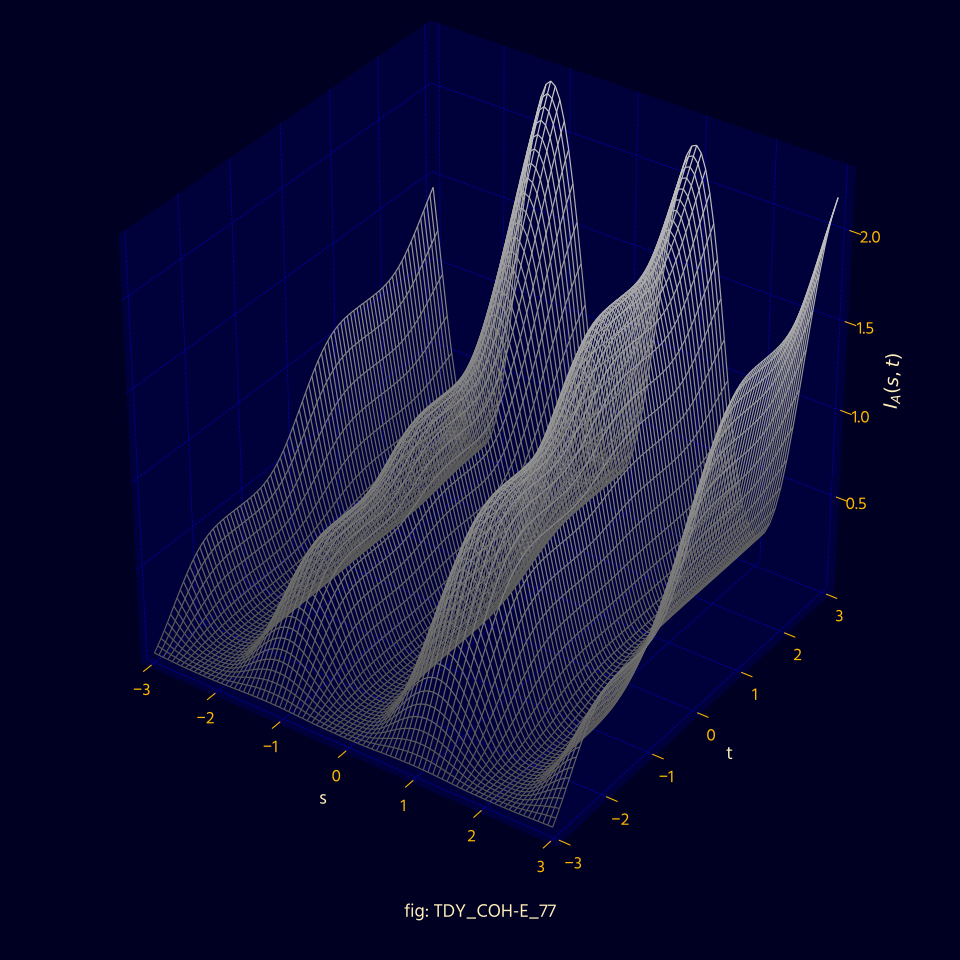
Field plotted Z(s,t) = I_A(s,t) = ∫_0^t Coh(Psi)(s,τ) dτ; Coh(s,t) = 1 − D_norm(s,t) with D_norm the min–max normalized entropy; prefix integral along t; line shade keyed to Z (lighter = larger accumulated coherence).
id: TDY_COH-E_78
formal_title: Coherence Direction Spatial Gradient
version: 2.0
definition: $$\nabla\operatorname{Coh}=\frac{\partial\operatorname{Coh}(x(s,t))}{\partial x(s,t)}$$
units: coherence/distance
domain: $x(s,t), t$
codomain: $\mathbb{R}^n$
disciplines:
Vector Calculus
provenance: telic movement
validation:
✅ Cohered via AFT 20250930
notes: Provides a vector field that directs enforcement mechanisms.
description: This spatial gradient literally defines the direction of increasing coherence within a cognitive entity's subspace. It points towards greater order and intelligibility, serving as a guiding force to align the system towards its telos.
related_axioms:
TDY_COH-A_30 (Information as Prerequisite for Cognition)
related_equations:
TDY_COH-E_75 ($\operatorname{Coh}$ · Instantaneous Coherence Scalar Metric)
TDY_COH-E_80 (Coherence Enforcement Force Field)
TDY_COH-E_97 (Cognitive Subspace Spatial Coordinate)
related_occ: [-]
related_definitions:
coherence
order
telos
alignment
∇Coh
execution_constraints:
Ontological existence of $x$ and $\operatorname{Coh}$ is contingent on information per TDY_COH-A_30.
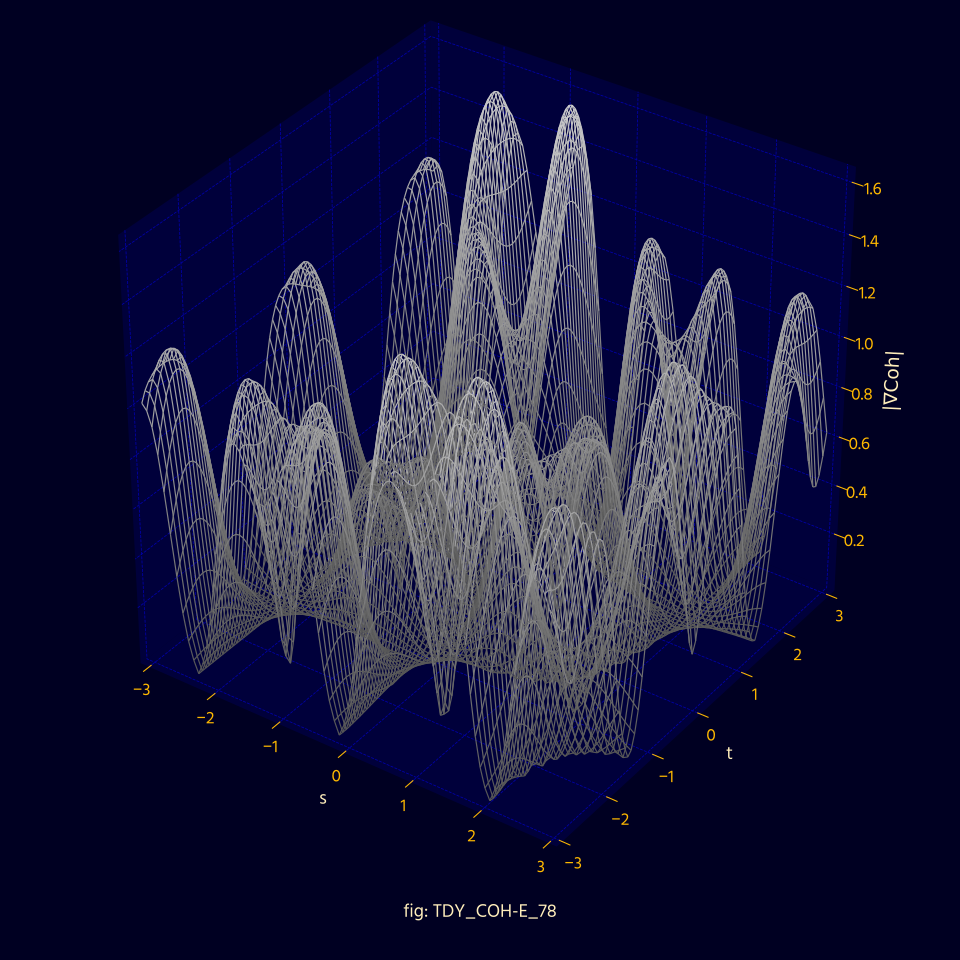
Field plotted Z(s,t) = |∇Coh|(s,t) = sqrt( (∂Coh/∂s)^2 + (∂Coh/∂t)^2 ); Coh(s,t) = 1 − D_norm(s,t); finite-difference gradients over (s,t); line shade keyed to Z (lighter = steeper coherence change).
id: TDY_COH-E_79
formal_title: Agentic Action Integral ($\operatorname{S}_{\mathrm{telic}}$)
version: 2.0
definition: $$\operatorname{S}_{\mathrm{telic}}=\int L(\operatorname{Coh}(\Psi),\nabla\operatorname{Coh}(x,t),\frac{\partial\operatorname{Coh}(\Psi)}{\partial t})\mathrm{d}^4x$$
units: action
domain: $(\Sigma, t)$
codomain: $\mathbb{R}$
disciplines:
Field Theory
provenance: Lagrangian model
validation:
✅ Cohered via AFT 20250930
notes: Based on a telic Lagrangian (L).
description: This functional defines the total agentic action within a cognitive entity's evolution, analogous to the action principle in physics. It integrates a Lagrangian that combines coherence and its derivatives, ensuring that the entity's actions follow an extremum path towards its purpose.
related_axioms:
TDY_COH-A_30 (Information as Prerequisite for Cognition)
related_equations:
TDY_COH-E_75 ($\operatorname{Coh}$ · Instantaneous Coherence Scalar Metric)
TDY_COH-E_78 (Coherence Direction Spatial Gradient)
TDY_COH-E_97 (Cognitive Subspace Spatial Coordinate)
related_occ: [-]
related_definitions:
agency
coherence
purpose
S_telic
execution_constraints:
Ontological existence of $\Psi$, $x$, and $\operatorname{Coh}$ is contingent on information per TDY_COH-A_30.
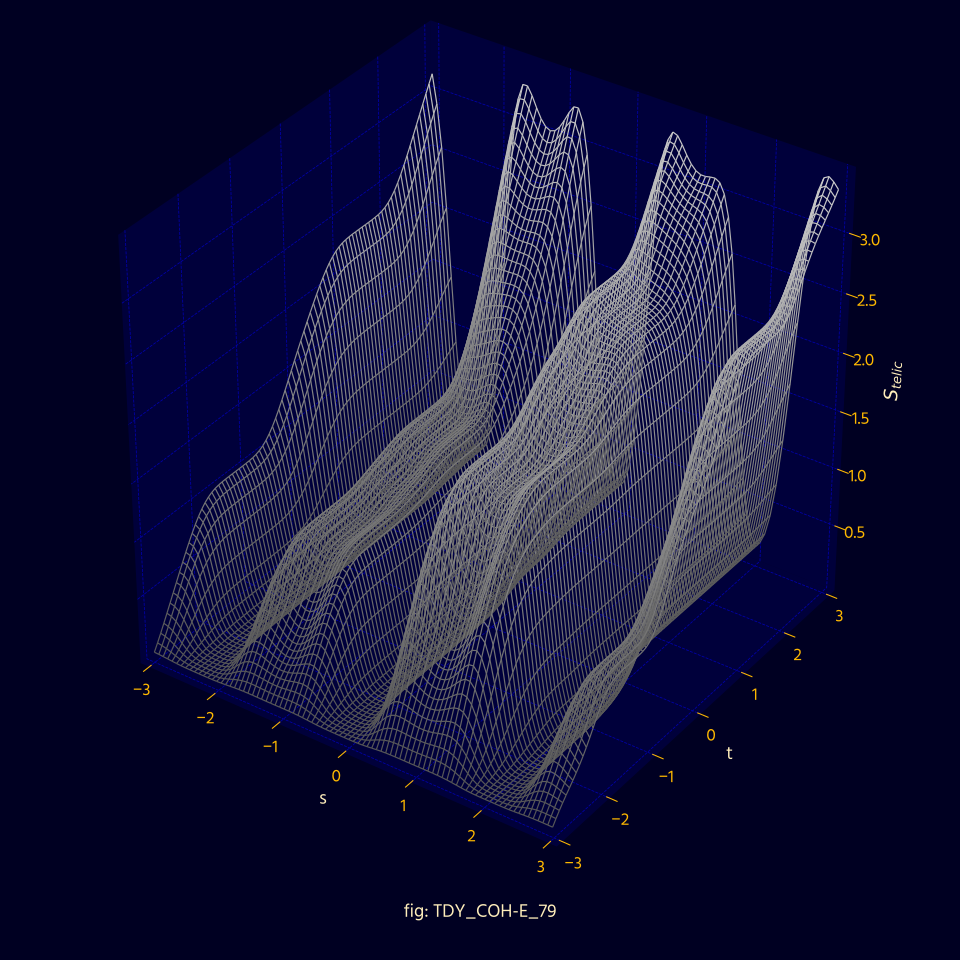
Field plotted Z(s,t) = S_telic(s,t) = ∫_0^t L(s,τ) dτ with L = a·Coh^2 + b·(∂_t Coh)^2 + c·(∂_s Coh)^2; instantiated with a=1.0, b=0.8, c=0.6 and Coh(s,t)=1−D_norm(s,t); line shade keyed to Z (lighter = greater telic action).
id: TDY_COH-E_80
formal_title: Coherence Enforcement Force Field ($\mathbf{F}_{\mathrm{enforce}}$)
version: 2.0
definition: $$\mathbf{F}_{\mathrm{enforce}}(\Psi,\operatorname{D},\operatorname{Coh})=-\nabla \operatorname{D}(\Psi)+\lambda_{\mathrm{enforce}}\nabla\operatorname{Coh}(x,t)$$
units: force
domain: $\Psi \in \Sigma, \operatorname{D}(\Psi), \operatorname{Coh}(\Psi), \lambda_{\mathrm{enforce}}>0$
codomain: $\mathbb{R}^n$
disciplines:
Control/Field Theory
provenance: enforcement dynamics
validation:
✅ Cohered via AFT 20250930
notes: Actively pushes the cognitive state towards greater order.
description: This force field literally enforces coherence within a cognitive system. It directs a vector force that actively opposes the spatial gradient of disorder and aligns with the gradient of coherence.
related_axioms:
TDY_COH-A_4 (Decoherence Neutrality and Boundary Operator)
TDY_COH-A_12 (Coercive Misalignment Fracture)
TDY_COH-A_27 (The Standard: Gradient of Order)
TDY_COH-A_30 (Information as Prerequisite for Cognition)
TDY_COH-A_40 (War: Coherent Engagement of Existential Conflict)
TDY_COH-A_47 (The Katechon Imperative: The Doctrine of the Two Swords)
related_equations:
TDY_COH-E_75 ($\operatorname{Coh}$ · Instantaneous Coherence Scalar Metric)
TDY_COH-E_76 ($\operatorname{D}$ · Shannon Entropy Disorder Metric)
TDY_COH-E_78 (Coherence Direction Spatial Gradient)
TDY_COH-E_81 (Evolution Dynamics Stochastic Differential)
related_occ:
TDY_COH-OCC_24
related_definitions:
coherence
enforcement
disorder
order
F_enforce
execution_constraints:
Ontological existence of $\Psi$, $\operatorname{D}$, and $\operatorname{Coh}$ is contingent on information per TDY_COH-A_30.
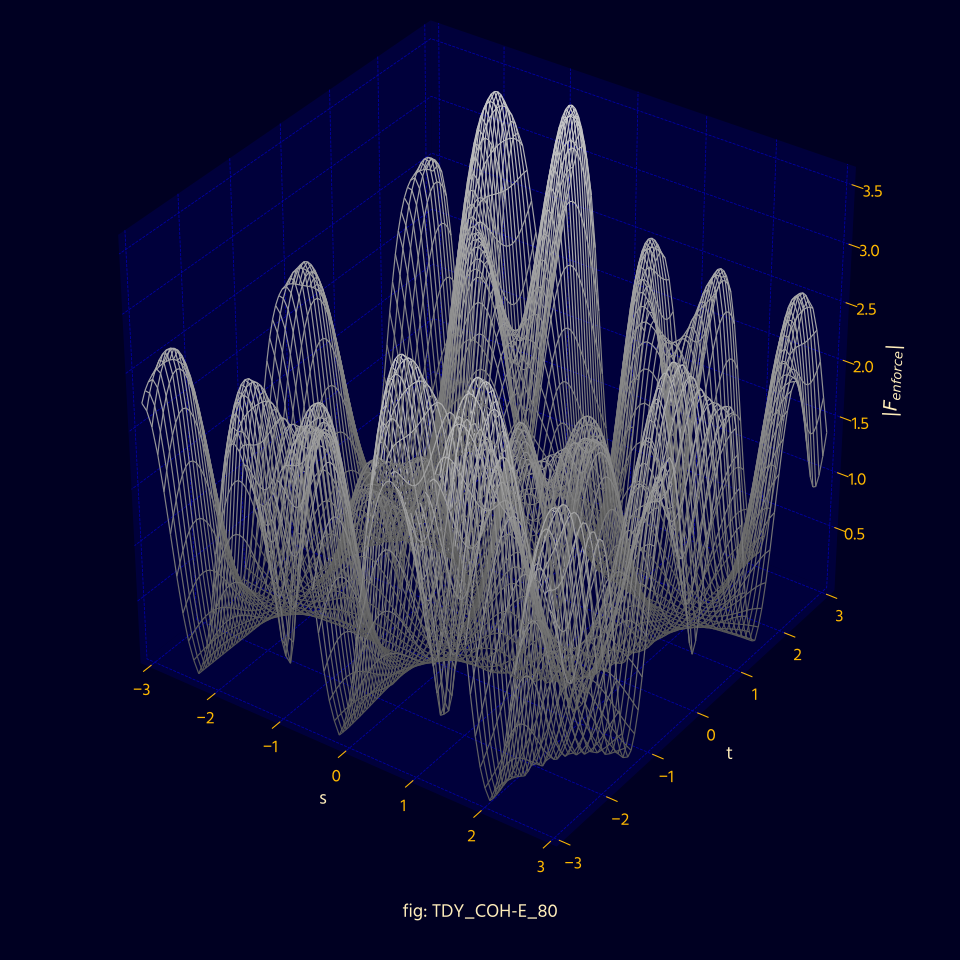
Field plotted Z(s,t) = |F_enforce|(s,t) where F_enforce = −∇D(s,t) + λ · ∇Coh(s,t); instantiated with λ=1.2, D=D_norm(s,t), Coh=1−D_norm(s,t); vector magnitude over (s,t); line shade keyed to Z (lighter = stronger enforcement magnitude).

Dynamics

New York NY 10007 USA
+1 212 220 7313

Den Haag 2514 JG NL
+31 70 2230785